There are already good weather apps, excellent navigation apps, and trip planners that will find you a campground with full hookups and a pull-through site.
Storm Recon isn't trying to be any of them. It exists because of the gap between them.
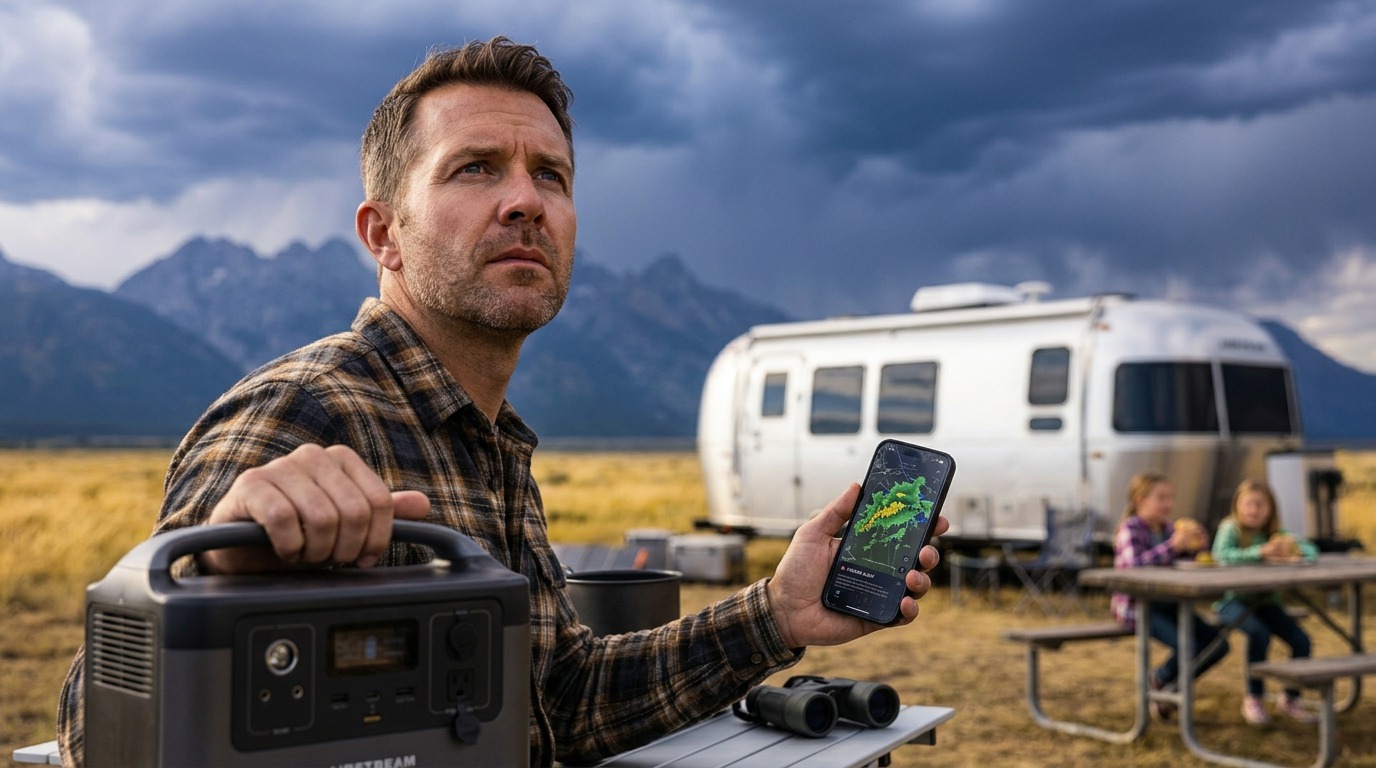
Picture the situation it was built for. You're parked somewhere for the night in an RV, a van, a truck camper. Something is developing — a line of storms two states west, a river rising upstream, a heat dome settling in, a fire burning on the wrong side of the wind. The information about it is public, free, and excellent. The National Weather Service published it hours ago. Maybe days ago. And none of it is in front of you, because nothing in your world is watching on your behalf.
Your weather app will show you a radar loop if you go open it. Your maps app will happily route you toward the flooding — it has no idea. Your trip planner did its job when you booked the site and hasn't had an opinion since. Every one of those tools is waiting for you to ask it a question. The problem is that at 2 a.m., asleep, you don't know there's a question.
The part in the middle
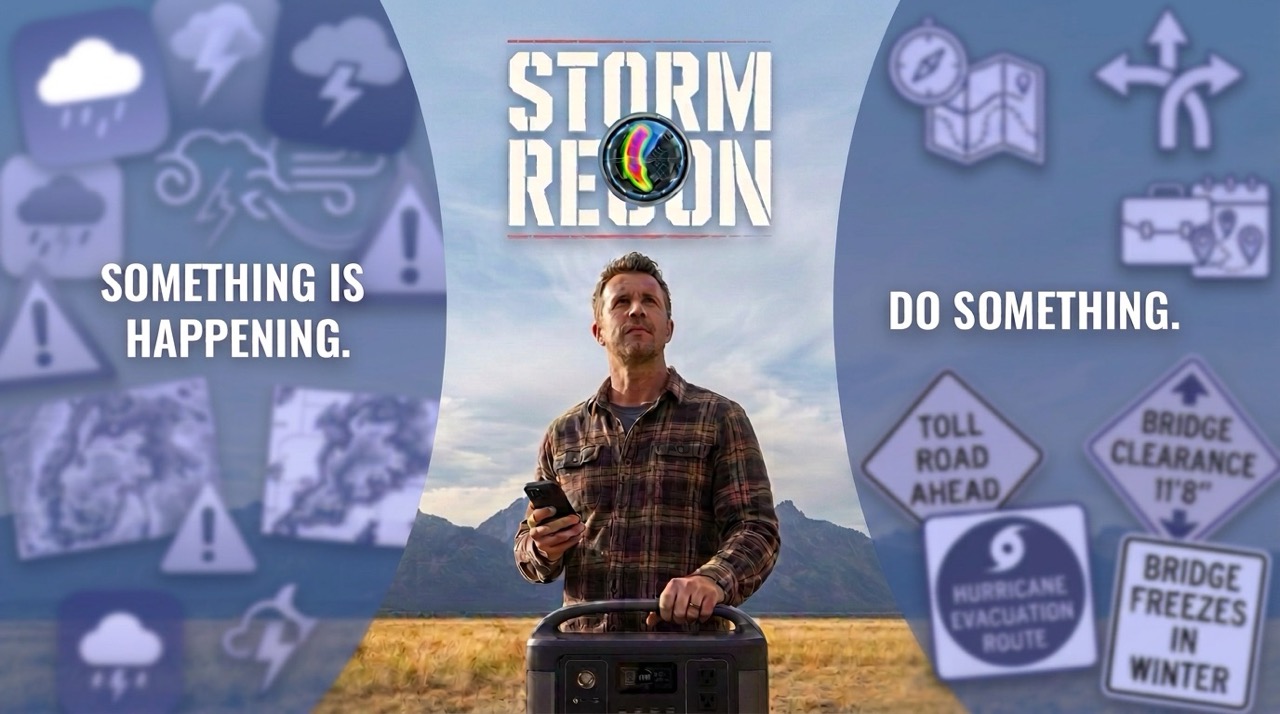
Draw a line down the middle of a page. On the left: something is happening. Weather systems, wildfire perimeters, official watches and warnings, radar returns, alert polygons with real severity attached.
On the right: do something. Stay put. Ignore it. Leave calmly in the morning. Leave right now. Drive northeast for ninety minutes and sleep somewhere else.
The user sits in the middle, and that middle is where the entire decision lives. Storm Recon is a logic layer built for that spot. It reads the left side, applies what it knows about you — how far ahead you want to look, which hazards you care about, what you're driving, whether you want to be interrupted — and gives you the right side as something specific enough to act on.
Not "severe weather in your area." Something more like:
What a recommendation actually says
"Leave by 4:15, go northeast, here are three places you could sleep, here's the honest tradeoff between them, and here's the button that sends it to Waze."
We don't forecast, and we say so constantly. We will never out-guess the National Weather Service. Everything on the "something's happening" side of that line comes from official public sources — NOAA and the NWS, the Storm Prediction Center, NASA's fire-detection satellites, the National Interagency Fire Center, the U.S. Geological Survey. All free, all authoritative, all used exactly as published. The gap we fill isn't a knowledge gap. The information already existed. It just never reached the person sleeping in its path.
And on the way out, we hand off. We're not building a turn-by-turn app when three excellent ones are already on your phone. You pick a destination in Storm Recon, tap once, and it opens in Google Maps, Waze, or Apple Maps. Our job ends where theirs begins.
What's actually hard about this
Almost none of it is the weather part. The hard part is the reasoning.
Say a flash flood warning is in effect. Should you drive? Twelve hours ahead of it, absolutely — get out early, that's the whole point. But once the water is on the road, driving is the single most likely way to die in a flood, and the advice inverts completely. Same hazard, opposite instruction, and the only variable is whether it has arrived yet. So before Storm Recon computes a single route, separate logic decides whether driving is even the right answer — shelter where you are, move on foot to higher ground, or drive. When it says driving isn't viable, the route engine isn't allowed to run.
Then there's what makes a route good. Short isn't good if it clips the storm. Fast isn't good if it puts you at a destination the weather reaches an hour after you do. And "good" isn't the same for everybody: a 34-foot travel trailer in a crosswind is a different animal than a Class B van, so they get different answers to the same storm. The app scores every candidate against the hazard class, your rig, the terrain, and whether the place at the end has power when the grid is about to go down — then solves for when, recommending the latest departure at which both the drive and the stay stay clear.
That's the machinery. You never see any of it. It has no pixels. It's most of the work.
How we tested it — and what the numbers actually were
Here's the part I most want to be straightforward about, because it's the real story.
We built our own test harnesses and we've been beating on this logic for months. Not "does it compile" testing — does it give good advice testing, graded by something other than the engine's own opinion of itself.
The best of them replays real history. Rather than invent scenarios, we drop a pin at a real place on a real date — a flood, a winter storm, a wildfire that actually happened — and replay the genuine archived federal record forward from that moment, with no hindsight. What would the app have known, and when? Where did it get it right, and where did it miss? Then we find out why it missed, fix it, and run it again. Every replay is exactly reproducible. There's an enormous amount of real, public, timestamped data available for this, and using it beats making things up.
That process caught a bug where one of the most severe products the Weather Service issues would have displayed as a routine warning — because it's technically a continuation of another product and doesn't announce itself by name. It caught two classification bugs that compounded into computing an evacuation route from an informational bulletin. It caught a crash on a real heat-watch calculation. None of those were found by reading code.
We score the engine on several objectives, 0 to 100, and our bar is 90 — where a recommendation is solid enough to act on without second-guessing.
The very first instrumented run
Route safety — the core of the whole product — came back at 12.5 out of 100.
Six rounds later
Diagnosis and repair, then run it again. It's at 95.3.
Same process, second objective
Routes returned went from 39.4 to 96.8.
Twenty-seven tuning rounds in total
Every one logged.
One score isn't there yet. The quality of the explanation — the sentence telling you why this route beat the other two — sits at 29.9 against our bar of 90. It's truthful; that part passes every time. But it isn't yet persuasive, and it doesn't do enough of the work of saying why not the other one. It's the next thing we're fixing. I'd rather tell you that than have you find it.
There's a second one like it: push notifications work today for hazards published with a map shape, but a big share of the feed — including most watches, which is exactly where the valuable lead time lives — publishes against county zones instead. Our matcher doesn't resolve those yet. Known, understood, being worked.
And one thing we don't do at all yet. The destinations we offer come from a set we've vetted ourselves, which means if you don't like any of the three, you're on your own from there. We're considering opening up the handoff so it can carry a search instead of a single pin — letting you ask Google or Waze what else is near the place we've cleared, and browse their answers in their app. Their database, their results, plainly not ours. It's on the list. Tell me if you'd use it.
Who built it
Me, and a lot of AI.
I'm not a programmer. I'm the director and the orchestra leader — I set the beat and the tempo, but I don't write the notation and I don't play the flute. I treat AI the way I'd treat any talented designer or engineer I'd hired: bring something to the party, don't wait for me to spell it out. Everything on the screen, AI helped build. But it was directed, argued with, and nudged at every step, and the unglamorous logic underneath is where nearly all the real work went.
It ships when it's right — and "right" isn't always what something scores on a test. This is a safety application.
If I wouldn't use it for my own family, it doesn't ship.
Try it
Please break it. That's not a courtesy line: real users pointing at real bad answers will fix that explanation score faster than we will alone.
Full launch is close. We'd like you along for it.